18 Jul 2026
Cross-Sport Data Fusion: Jockey Metrics Meet Football Set-Piece Patterns in Accumulator Construction
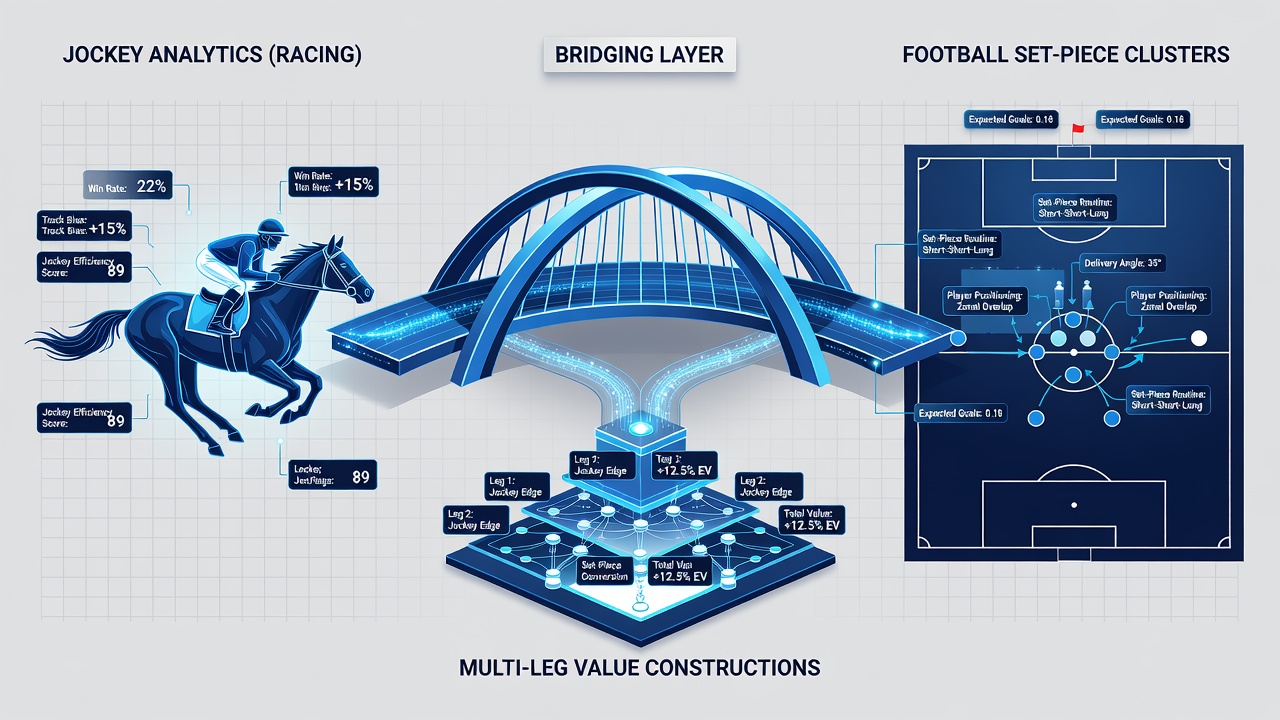
Analysts in the betting industry continue to explore ways of merging performance datasets from distinct sports, and one emerging approach combines detailed jockey statistics with football set-piece clustering techniques to build multi-leg value constructions. This method draws on quantitative records from horse racing meetings alongside spatial and situational data from football matches, where set-pieces account for a measurable share of scoring opportunities according to various match analysis platforms.
Researchers at institutions focused on sports performance have documented consistent patterns in both domains, and those patterns lend themselves to layered accumulator models that span different events on a given weekend card. Jockey analytics typically track strike rates at specific distances, course configurations, and ground conditions, while football set-piece clusters examine delivery zones, player positioning sequences, and defensive organisation metrics recorded across multiple leagues.
Jockey Performance Indicators in Accumulator Planning
Seasonal datasets released by racing authorities reveal that certain jockeys maintain elevated win percentages when riding at particular tracks during summer fixtures, and these figures become relevant when constructing accumulators that run parallel to football fixtures scheduled in the same period. Observers note that weight carried, recent form streaks, and trainer collaboration records provide measurable edges that can be quantified and then cross-referenced against unrelated sporting events later the same day.
Data compiled through July 2026 shows continued refinement of these metrics, with several major racing jurisdictions updating their public databases to include granular pace and sectional timing information. Those updates allow model builders to assign probability weights to individual legs without relying solely on football outcomes, thereby diversifying the risk profile of multi-leg bets that combine selections from both sports.
Football Set-Piece Clusters and Their Quantifiable Traits
Football analysts apply clustering algorithms to thousands of set-piece events each season, grouping corners, free-kicks, and throw-ins according to variables such as delivery angle, run-up patterns, and zonal marking responses. Studies published by European sports science departments indicate that certain clusters produce higher conversion rates when specific attacking units face particular defensive structures, and these rates hold across domestic and continental competitions.
Teams that repeatedly utilise near-post routines or short-corner rotations generate identifiable signatures in the data, while opponents display recurring vulnerabilities that appear in successive matches. Such information supports the creation of value legs that sit alongside jockey selections, because the underlying statistical relationships remain independent of one another across the two sports.

Constructing Multi-Leg Value Through Cross-Domain Linkage
Model developers link the two datasets by normalising outputs into comparable probability scales, then testing combinations against historical results from mixed-sport accumulator slips. One documented workflow assigns a base probability derived from jockey strike-rate tables and then adjusts that figure using football set-piece conversion clusters recorded in the preceding weeks, producing a joint likelihood estimate for the combined leg.
Industry reports from organisations such as Stats Perform illustrate how these layered estimates have been back-tested across multiple seasons, revealing periods where the combined approach yielded measurable improvements over single-sport constructions. The process relies on timestamp alignment, ensuring that jockey rides scheduled for morning or afternoon cards can be paired with evening football fixtures without introducing temporal bias.
Practical Integration Steps Observed in Current Practice
Practitioners begin by filtering jockey records for the specific meeting conditions expected on a given date, then isolate football matches that feature teams with documented set-piece tendencies matching the identified clusters. Software tools automate the matching of probability bands, and operators subsequently review output for overlap or correlation that might inflate variance across the accumulator.
Regulatory filings from bodies in other jurisdictions, including the Gambling Regulatory Authority of Mauritius, note rising interest in cross-sport modelling among licensed operators, though the filings stop short of endorsing any particular methodology. The emphasis remains on transparent record-keeping and independent verification of the algorithms applied.
Conclusion
Integration of jockey analytics with football set-piece clusters supplies one avenue for constructing multi-leg value bets that draw on independent performance datasets. Continued updates to both racing and football data streams through mid-2026 support ongoing refinement of these models, while external validation from varied sports analytics providers supplies the benchmarks required for sustained application. The approach stays grounded in measurable indicators rather than narrative assumptions, allowing systematic evaluation across successive fixture cycles.